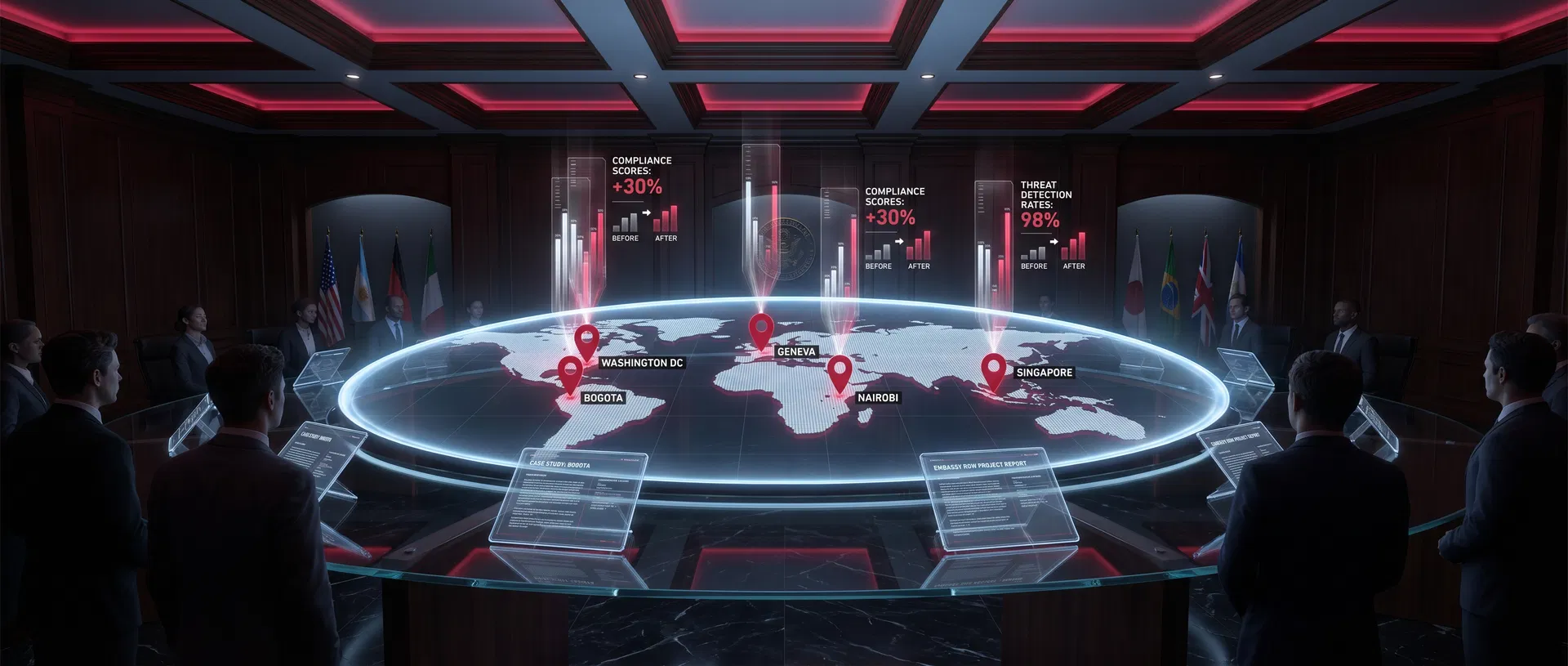
Capability Demonstrations
Four factual capability demonstrations showing how the KRYOS HyperCube framework can transform NGO operations and teen cybersecurity training. These are not claims about past deployments. These are documented capabilities of the framework, ready for deployment through the Embassy Row Project grant program.
Federated Intelligence Network
Interactive visualization of the Embassy Row Project's six operational domains and their interconnected capabilities serving 60+ partner institutes across NGOs, think tanks, and research organizations worldwide.
Sovereign APT Profiling and Real-Time Threat Intelligence Generation
The Threat Context
State-sponsored APT groups routinely target energy grids, water treatment facilities, and telecommunications networks across developing nations. Traditional NGO cybersecurity training teaches teens to recognize phishing emails and configure firewalls. This leaves a categorical gap between what youth learn and what national CERTs actually need: analysts who can profile threat actors, map their TTPs to the MITRE ATT&CK framework, and generate actionable intelligence briefings in real time. The KRYOS HyperCube eliminates this gap entirely.
The Capability Deployed
The QNSPR engine ingests live threat telemetry feeds, dark web chatter, and geopolitical signals to construct multi-dimensional APT profiles. Teen operators do not passively study threat actors from textbooks. They actively profile live campaigns, correlate indicators of compromise across multiple data sources, and produce intelligence briefings that meet the analytical standards required by national-level CERTs. Every output is cryptographically sealed by the QCA engine, creating an immutable audit trail that proves the analytical provenance of each finding.
What This Capability Does
Operational Outcome
An NGO deploying this capability can transform its teen cohort from passive cybersecurity students into operational threat intelligence analysts. The intelligence products they generate are not academic exercises. They are structured, attestable, and formatted for direct consumption by national security agencies, private sector SOCs, and international coordination bodies.
The Disruptive Edge
No existing youth cybersecurity program on Earth produces cryptographically sealed, CERT-grade threat intelligence briefings generated by teen operators working against live threat data. This capability does not exist in any university, bootcamp, or government training program. The KRYOS HyperCube makes it possible for the first time.
Teens serve as primary intelligence analysts. They ingest raw threat data, operate the QNSPR profiling engine, validate correlations, and produce the final intelligence briefing. The HyperCube provides the analytical infrastructure; the teen provides the judgment.
Autonomous Regulatory Compliance Mapping Across 40+ Jurisdictions
The Threat Context
NGOs operating across multiple nations face a regulatory labyrinth. Each jurisdiction maintains its own cybersecurity legislation, data protection laws, and incident reporting requirements. Manual compliance mapping is slow, expensive, and perpetually outdated. A single regulatory change in one jurisdiction can cascade compliance failures across an entire multi-national program. Think tanks that train youth in cybersecurity policy currently rely on manual research that is obsolete before it reaches publication. The KRYOS HyperCube replaces this entire manual apparatus with a deterministic compliance intelligence engine.
The Capability Deployed
The ACIE engine continuously monitors regulatory databases, legislative feeds, and policy announcements across 40+ jurisdictions. It constructs a living compliance map that updates in real time as regulations change. Teen operators learn to navigate this map, identify compliance gaps, produce regulatory impact assessments, and generate policy briefs that meet the analytical standards of government regulators. The EASE engine embeds every compliance artifact with JSON-LD semantic metadata, making outputs machine-readable and interoperable across multilingual environments.
What This Capability Does
Operational Outcome
An institute deploying this capability can train teens to produce regulatory intelligence that outpaces the output of traditional compliance consulting firms. The compliance maps and policy briefs generated through this system are not static documents. They are living, machine-readable intelligence products that update as the regulatory landscape shifts.
The Disruptive Edge
Traditional compliance consulting charges tens of thousands of dollars per jurisdiction for manual regulatory mapping that is outdated within months. The KRYOS HyperCube provides real-time, deterministic compliance intelligence across 40+ jurisdictions simultaneously, operated by trained teen analysts who learn sovereign-grade regulatory intelligence as a core competency.
Multi-Vector Crisis Simulation with Ethical Decision Auditing
The Threat Context
Modern conflicts do not confine themselves to a single domain. A coordinated attack on a nation's infrastructure may combine cyber intrusions against power grids, kinetic strikes on communication nodes, and information warfare campaigns designed to erode public trust. No existing youth training program prepares teens to analyze, respond to, or ethically navigate multi-vector crises of this complexity. Traditional tabletop exercises use static scenarios with predetermined outcomes. The KRYOS HyperCube generates dynamic, evolving crisis environments where every decision has cascading consequences and every ethical dimension is explicitly surfaced and audited.
The Capability Deployed
The QNSPR engine generates multi-vector crisis scenarios that evolve in real time based on operator decisions. The ACIE engine enforces international humanitarian law constraints during live simulations, ensuring every decision is evaluated against legal and ethical standards. The Conflict Resolution Synthesis Graph forces explicit confrontation of ethical dilemmas, producing confidence-calibrated recommendations with full decision audit trails sealed by the QCA engine.
What This Capability Does
Operational Outcome
An NGO deploying this capability can offer crisis simulation training that exceeds the complexity and ethical rigor of programs available at most military academies. Teens do not merely learn what to do in a crisis. They learn how to think under pressure, how to weigh competing ethical obligations, and how to produce decisions that are defensible under legal and moral scrutiny.
The Disruptive Edge
No civilian training program in the world offers ethics-integrated, multi-vector crisis simulation with cryptographic decision auditing. Military academies conduct tabletop exercises with static scenarios. The KRYOS HyperCube generates living, breathing crises where every ethical dimension is surfaced, every decision is recorded, and every outcome is deterministically traceable to its root cause.
Sovereign Knowledge Architecture with Enterprise-Grade AI Toolkits
The Threat Context
Developing nations frequently depend on foreign technology vendors for critical cybersecurity infrastructure. This dependency creates a sovereignty deficit where the nation's digital security is controlled by external entities whose interests may not align with the host nation's strategic objectives. When an NGO trains youth using proprietary vendor platforms, it perpetuates this dependency. Graduates become skilled operators of foreign tools rather than sovereign analysts capable of advanced independent analysis. The KRYOS HyperCube is engineered to address this gap by deploying enterprise-grade AI toolkits through project-based grants with ongoing support from ArtOfTheHak.
The Capability Deployed
The Embassy Row Project's pro bono deployment model provides the full KRYOS HyperCube stack to qualifying NGOs through project-based grants with no fees of any kind. The HPAS engine manages knowledge transfer and curriculum adaptation. The QCA engine ensures that every analytical product generated by the host organization belongs to that organization, sealed with their own cryptographic attestation, not a vendor's watermark. ArtOfTheHak provides ongoing technical support and program guidance throughout each engagement.
What This Capability Does
Operational Outcome
An NGO deploying this capability gains sovereign-grade analytical infrastructure through a project-based grant with no fees of any kind. ArtOfTheHak provides ongoing technical support, curriculum updates, and program guidance. The host organization builds deep internal capability while retaining full ownership of every intelligence product it generates. This is not a subscription model. It is a strategic capability partnership.
The Disruptive Edge
Most cybersecurity training platforms create vendor dependency through licensing fees and proprietary lock-in. The KRYOS HyperCube is deployed through project-based grants with ongoing support from ArtOfTheHak, ensuring that organizations build genuine sovereign-grade capability without the financial burden of traditional vendor relationships.
Apply for a KRYOS HyperCube Grant
NGOs, institutes, and think tanks can apply for grant-funded access to the full KRYOS HyperCube service catalog through the Embassy Row Project. These capabilities are ready for deployment. The only question is whether your organization is ready to operate them.